
Federal BOP Release Routes
Federal Bureau of Prisons facilities are a conditional branch of a Texas County release search. The research found no federal prison inside Texas County. An ordinary arrest handled by the Texas County Sheriff does not become a BOP case merely because the person no longer appears locally. First obtain the county jail register entry and read the stated discharge destination. A handoff to a federal authority means custody changed hands. It is not the same event as a return to the community.
The BOP Inmate Locator is designed for people held in the federal prison system. It can also contain records for some pretrial detainees, material witnesses, and people held for civil contempt. A match therefore proves a federal custody record, not by itself a federal conviction. Read the federal court docket for the legal basis and use the locator for the custody status. For the local side, use OSCN case search and obtain an official item through the Texas County Court Clerk. This division matters when a Texas County arrest leads to a separate federal proceeding.
| County record says | Next source | What to confirm |
|---|---|---|
| Released to BOP | BOP locator | Federal location or release wording |
| Released to USMS | Federal docket and USMS inquiry | Pretrial or transport authority |
| Released to ICE | ICE locator | Current immigration custody |
| Community release | Sheriff register and court | Date, manner, and case status |
Check a Federal Release Record
A strong BOP search uses the most specific identifier available. The federal locator accepts a BOP Register Number, DCDC number, FBI number, or INS number. It also permits a name search with age, race, and sex as matching aids. Names can be shared, misspelled, or recorded under a prior form, so compare every displayed identifier before deciding that the result belongs to the person sought.
- Open the official BOP locator and choose the number search when a federal identifier is known.
- Otherwise enter the full name and add the available identifying fields to narrow namesakes.
- Open the matching record and preserve the exact location or release wording and the date shown.
- Compare the federal case and Texas County jail-register destination before joining the records.
- If the person is no longer in BOP custody, check the next custodian indicated by the evidence.
The locator is a fast public index, not a certified release instrument. For a legal deadline or a disputed identity, obtain the court order or a properly requested agency record. The Texas County released-inmate search and records path explains how the sheriff entry and local docket fit beside this federal result.
Read BOP Release Status
BOP describes public result fields that may include a name, register number, age, race, sex, release date, and location. A past date paired with a released location indicates that the person is no longer held by BOP. A future date is projected, so it should not be repeated as an actual departure. The label UNKNOWN means the confinement term is undetermined. It does not mean release is near or that the agency lost the record.
- Released
- The BOP custody episode shown by the locator has ended.
- Projected date
- A future calculation that may change before departure.
- Not in BOP custody
- A scope statement about BOP, not all government custody.
- Supervised release
- A court-ordered federal supervision term that can follow imprisonment.
Can a person be released by BOP but still not be free? Yes. Another sovereign may take custody, ICE may act, or federal supervised release may begin. Use the destination and court record instead of expanding one agency's label beyond its scope.
Texas County Federal Transfers
The Texas County jail register is the local pivot. Under 51 O.S. § 24A.8, the register includes the date or manner of discharge or escape when the record is kept. Ask for both the timestamp and the destination or release code. If the response uses an abbreviation, request the existing code legend. Do not guess that a short code means community release.
A county discharge to USMS can precede BOP designation. During that gap, a BOP search may fail even though federal custody is active. The U.S. Marshals Service transports and holds federal pretrial prisoners and may place them in contract facilities. It does not publish a comparable historical release roster. The federal docket, counsel or court release order, and a focused records inquiry are the better bridge until a BOP record appears.
A missing BOP result does not confirm release. It may mean the person is in county, state, immigration, pretrial federal, or another authority's custody.
BOP Locator Fields Explained
The official locator's result should be copied with context. Record the date of access because public status can change. Keep the register number with the result, and distinguish the federal release date from any Texas County bond date, sheriff discharge date, parole date, or later sentence-discharge date. These dates answer different questions.
The official BOP search form illustrates the federal number and name routes available to a Texas County researcher.
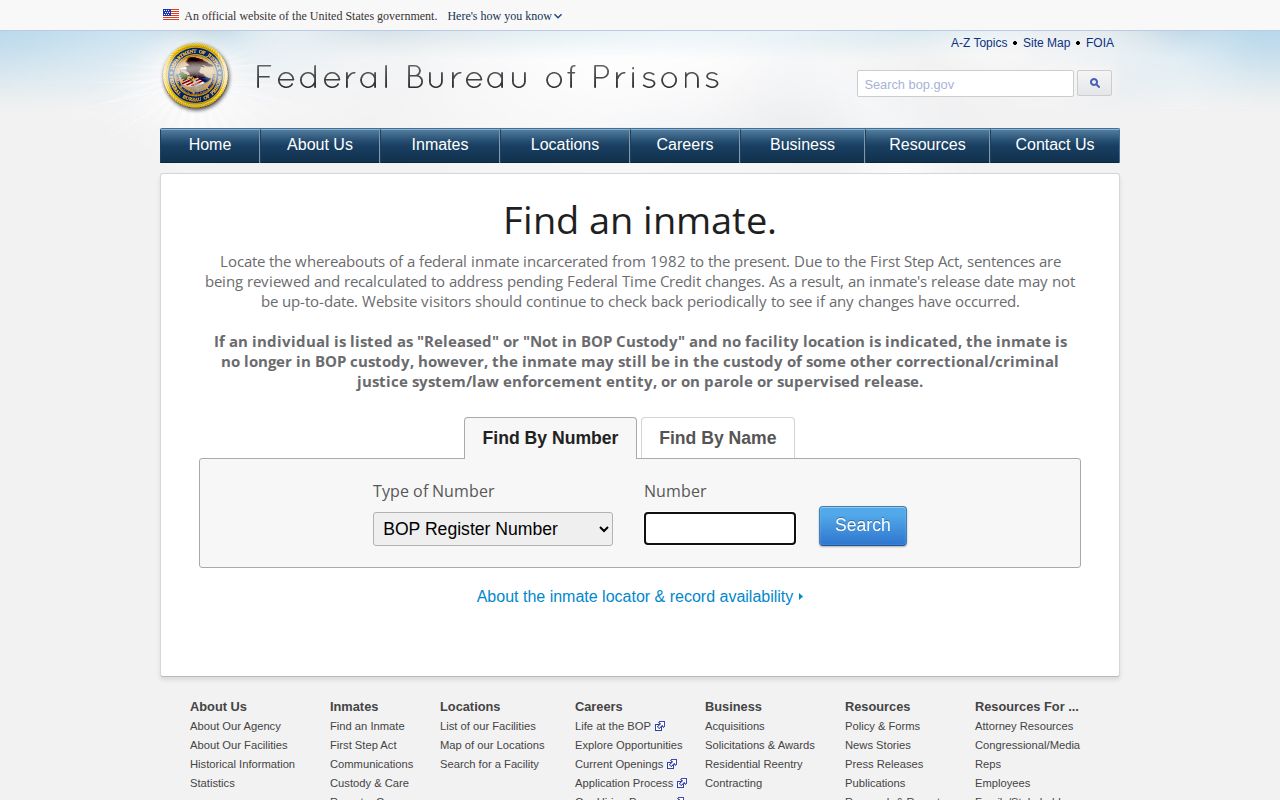
The screen is useful because it shows the source's own search structure. It should never be read as a Texas County jail roster or used to assign an identity without matching details.
| Field | Use | Caution |
|---|---|---|
| Register number | Strong federal identifier | Compare every digit |
| Release date | Past or projected BOP date | Label future dates as projected |
| Location | BOP facility or released wording | Does not show all custodians |
| Name details | Namesake check | Never match by name alone |
Obtain Federal Release Records
When the locator does not answer the precise question, identify the smallest existing document that will. The federal court docket can establish a detention or release order. BOP records may address a sentence or confinement episode. USMS records may address pretrial custody or transport. A request should give the full name, known federal number, case number, and a narrow date range. It should ask for an existing release, transfer, or custody record rather than demand that staff decide whether the person was “really free.”
Privacy and law-enforcement exemptions can limit access. A response may be redacted, and a public locator will not expose all case details. If one component says it does not hold the record, ask which component or custodian received the person. Retain that answer with the Texas County jail entry. This creates a traceable chain instead of relying on a missing search result.
Inmate Locator
Federal inmate record information
Nationwide federal custody system
Note: No BOP institution was identified inside Texas County; the nationwide system applies only when federal custody is supported by a record.
Confirm the Final Custodian
End the search by reconciling scope. The sheriff confirms departure from Texas County custody. BOP confirms the status of a federal prison record. The federal court explains the case and any supervised-release term. ICE covers immigration detention, and ODOC covers Oklahoma prison or community-supervision records. None of these sources can speak for every other one.
Use positive evidence. A dated sheriff entry that names USMS, a matching federal number, a BOP result with exact status wording, and a federal docket event form a far stronger record than absence from a roster. If dates conflict, keep each agency label and seek the underlying order or release document. Do not force one timestamp to stand for booking, transfer, physical release, and sentence completion.
The clean custody flow is: Texas County booking → documented federal handoff → USMS or BOP custody → BOP release or transfer → any court-ordered supervision. A different record may skip several stages. Follow only the stages supported in the individual case.
Texas County Federal Record Reconciliation
Reconcile the county and federal records in date order. The Texas County booking date begins the local episode. The sheriff's discharge field marks when that episode ended and should name the manner or destination if recorded. A USMS transfer date can follow, while a later BOP reception or release date belongs to the federal prison record. A federal court order may fall between those events without serving as the transport timestamp.
Keep each unique number with its source. The county booking number identifies the local stay, the federal case number identifies the proceeding, and the BOP Register Number identifies the federal locator record. A shared name is not enough to merge them. If the date sequence contains a gap, ask the named custodian for the smallest existing record that covers it rather than filling the gap from assumption.
After a BOP release, read the federal judgment for supervised release and check any documented transfer. A BOP departure can lead to community supervision, ICE, state custody, or another authority. The final safe statement should identify only the system that the record actually confirms.