
Texas County Three-Day Release Window
No official Texas County roster or rolling 72-hour release view was found. The Sheriff page, county home, directory, and local service menu do not link one. There is also no verified sheriff app for jail releases or booking photos. The three-day page must therefore function as an access method, not a simulated list of names.
A 72-hour interval is useful because it spans more than one date and can include a weekend boundary. It does not guarantee that the jail processed or supplied records on each of those days. Define the actual beginning and ending timestamps in Oklahoma local time. Do not assume that the Sheriff uses midnight cutoffs, rolling logic, or a delayed posting schedule because none is published.
Request Texas County 72-Hour Releases
Send a narrow request to the Texas County Sheriff for existing jail-register entries. The office is listed at 1102 S. Ellison, Guymon, OK 73942, 580-338-4000, matt.boley@texascountyok.gov. Posted hours are 8:00 a.m. to 5:00 p.m., closed at noon. No dedicated jail-record form, fixed response time, or sheriff fee table was verified.
- Select an ending timestamp and count back exactly 72 hours.
- Write both timestamps with the date, time, and local time context.
- Ask for existing register rows whose discharge time falls within that closed interval.
- Specify the name, booking identifier, commitment facts, discharge timestamp, and manner or destination fields.
- Ask for an existing electronic export, any code legend, and a cost estimate before copying.
- Save the request and response times so the interval remains clear.
A custodian may ask for more detail. Narrow the range or record type rather than asking staff to decide who was “actually free.” The Open Records Act provides access to records. It does not require new calculations, a custom narrative, or a public web feed.
Texas County 72-Hour Release Fields
No verified Texas County online list supplies a published field inventory. The grounded inventory comes from 51 O.S. § 24A.8. It covers jail-register information if kept, including the person's name, commitment information, description, and date or manner of discharge or escape.
| Field | Reason to request it |
|---|---|
| Name and description | Distinguishes the person from a namesake |
| Booking number | Links the row to one jail stay, when kept |
| Commitment date and cause | Identifies the start and stated basis of custody |
| Committing authority | Points toward the court or agency record |
| Discharge date and time | Places the event within the 72-hour interval |
| Discharge manner or destination | Separates community release from transfer or another event |
If the release manner appears as a code, ask for the existing legend. Do not decode an abbreviation by guesswork. Request a booking photo separately if needed and if it is kept and open. The statute's jail-register clause does not expressly enumerate the photograph.
Texas County Three-Day Record Basis
The Oklahoma jail-register provision shows why a date-bounded request is available even without a county release website.
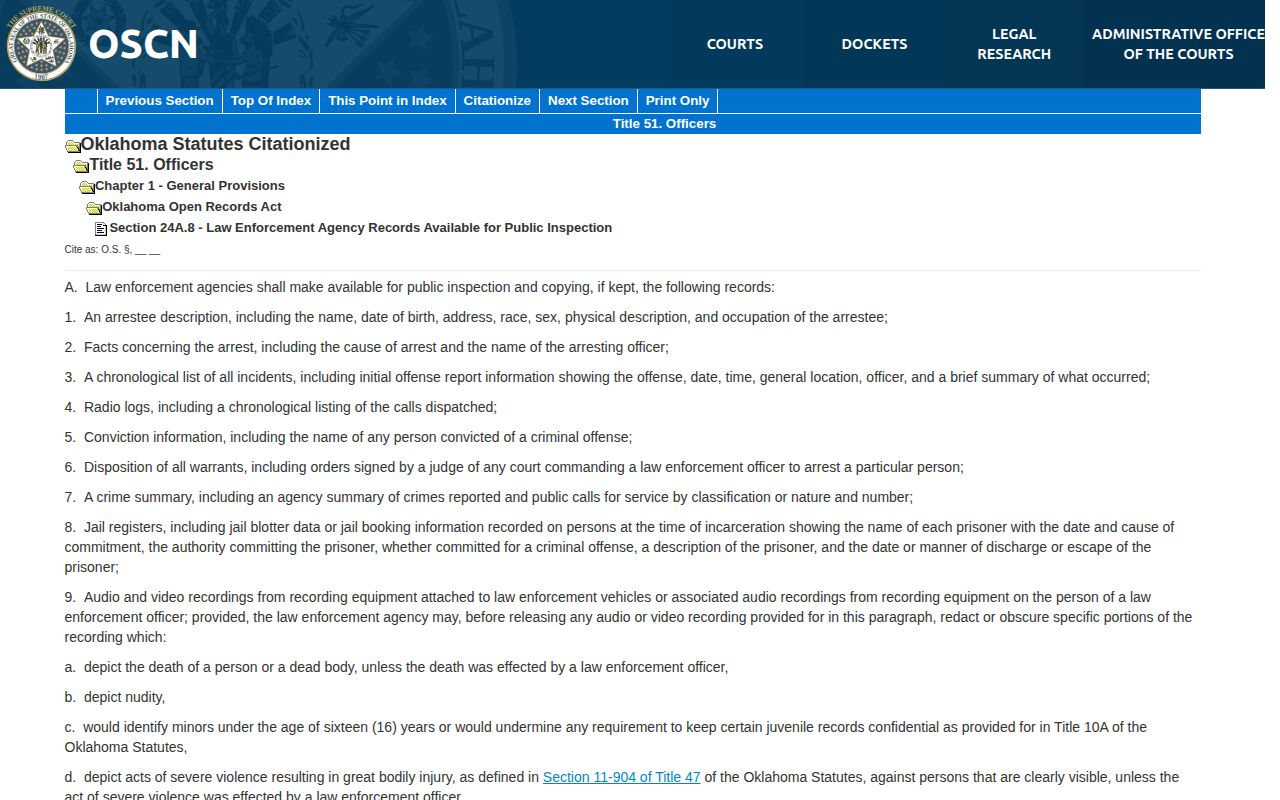
The law supports access to specified data that the agency keeps. It does not prove that Texas County maintains a prebuilt 72-hour report.
The general Open Records Act requires prompt, reasonable access but sets no fixed response-day deadline. No local retention period was found for an online release archive because no archive was verified. If older rows are unavailable, ask what schedule controls the jail register, release log, and booking file. Do not interpret a missing record as proof of a release.
Texas County Weekend Release Checks
A Friday-to-Monday interval can catch events that a same-day question misses. Yet the wider request must not be described as a Sheriff weekend feed. No official source states that Texas County posts records each day, publishes on holidays, or processes releases at a fixed hour. A court may issue an order before jail staff finish checks, property return, or another hold review.
Start with the physical discharge record. Then use the court docket for the legal cause. If a bond was posted, a charge was dismissed, or a sentence was modified, the docket can explain the authority. Another hold can still delay departure. For state-prison transfers, a local jail discharge marks the handoff, not a free-community event.
A 72-hour result may include escape, death, or transfer because the statute describes date or manner of discharge or escape. Keep those categories apart. Counting them all as released inmates would blur facts that determine where the person should be sought next.
Note: Holidays may affect office access, but no Texas County holiday posting or release schedule was verified in the official sources.
Verify Texas County Three-Day Results
Match each entry against the system named by its destination. For a community release, search OSCN for the Texas County case, then request the official minute or judgment from the Court Clerk if needed. The web docket is a navigation tool, not the certified court record.
| What the register says | Where to continue | What that source answers |
|---|---|---|
| Bond, recognizance, time served | Texas County court record | Case event and continuing terms |
| ODOC transfer | ODOC Offender Search | State prison or supervision status |
| Another jail | Receiving custodian | Continued local custody |
| USMS or BOP | Federal docket and BOP when applicable | Federal custody branch |
| ICE | ICE detainee locator or official phone line | Immigration custody within system scope |
Oklahoma VINE may support a specific-person custody check and future alerts. Its participating-agency data can lag and it is not a certified release archive. For a full named-person search across systems, use the Texas County released inmates hub.
Texas County Release Data Retention
There is no official Texas County online retention window to quote. The lack of a web result after 72 hours does not mean the government record vanished. Section 24A.8 states that, absent another specific rule, law-enforcement records are maintained as long as needed for administrative purposes. Ask for the applicable local schedule rather than importing a period from another sheriff.
Search promptly and keep the requested dates narrow. If staff cannot locate a “release list,” ask whether the same facts appear in the jail register, booking entry, discharge log, or another named system. If a record was disposed of, ask for the authority or schedule that applied. A written answer is more useful than an unsupported inference from a commercial mirror.
The official Sheriff contact page is the correct local starting point.

The source documents the custodian and contact route without claiming that a rolling release display exists.
Texas County 24 Versus 72 Hours
The 24-hour request is best for a tightly bounded, recent event. It is easier to review and may produce fewer rows. The 72-hour request gives more context across several dates and can catch a weekend span, but it may include more bookings and more types of discharge. Neither interval is a published Texas County Sheriff product.
For same-day checking, use the Released Last 24 Hours method and record the current endpoint. For a three-day slice, keep both endpoints fixed even if the Sheriff responds later. If only one person matters, provide the name plus booking or case details instead of requesting every row.
The key distinction stays the same. A live-custody answer shows who is held at that moment. A discharge register shows what happened to a past jail episode. ODOC, BOP, ICE, and supervision records cover other custodians or later stages. The window alone never identifies the person's final destination.
Match Texas County Release Rows
Compare entries by booking episode rather than name alone. One person can have more than one booking, and two people can share a name. A case number, booking identifier, commitment date, and discharge destination make the match more reliable. If a row falls exactly on an endpoint, state whether the request includes that boundary so the three-day set can be reproduced.
Keep the response date with the export. The interval describes when the recorded discharges occurred, not when the Sheriff sent the record or when a court order was filed.