
Texas County Projected Versus Actual Release
The Oklahoma Pardon and Parole Board defines a Projected Release Date, or PRD, as ODOC's estimated release date. Board materials place `PE DATE` and `PRD` in separate columns. PE is parole eligibility, the point at which consideration may occur. PRD is a sentence calculation. Neither field is the same as the date a person physically leaves custody. Record the access date because a later official calculation may reflect new credits or sentence data.
A pretrial Texas County detainee usually has no fixed release date. Custody may change after bond, a dismissal, a plea, a court order, or transfer. A sentenced county-jail prisoner may have a locally calculated date based on the judgment, jail credit, and applicable county-jail credit law. A state prisoner follows ODOC calculation rules. Mixing those tracks creates false dates.
- PRD
- ODOC's calculated estimate for release.
- PE date
- The date parole consideration may begin under the governing law.
- Discharge
- The documented end of a custody or sentence stage.
- Detainer
- A request or hold from another authority that may affect transfer or departure.
Find a Texas County Inmate Release Date
Begin with the sentence source. The OSCN docket search can be filtered to Texas County and searched by case number or party. Read the judgment, not just a summary. Identify each count, the sentence date, jail-time credit, suspended part, and whether terms run concurrently or consecutively. A concurrent term runs at the same time as another; a consecutive term begins after another term.
- Determine whether the person is pretrial, serving a Texas County jail sentence, or committed to ODOC.
- For ODOC custody, search the ODOC Offender Search by DOC number when possible. Look only for a PRD that official material actually displays.
- For a county-jail sentence, ask the Texas County Sheriff for the calculation record and jail-register entry. Compare it with the court judgment.
- Check whether Title 21 § 13.1 applies to the offense and date, and whether the sentence has mandatory terms.
- After the forecast passes, confirm the actual date and manner of discharge through the responsible agency.
ODOC warns that its public lookup is abbreviated and is not an exact statement of offense details, sentence structure, or time remaining. Its FAQ also says the exact release date may be confidential without an authorized need, while the prisoner receives a days-remaining calculation. Use careful wording: look for any PRD displayed in official material rather than promising that every public result contains one.
The successful offender-search capture demonstrates the current official interface. Open the ODOC search source before relying on a saved result.
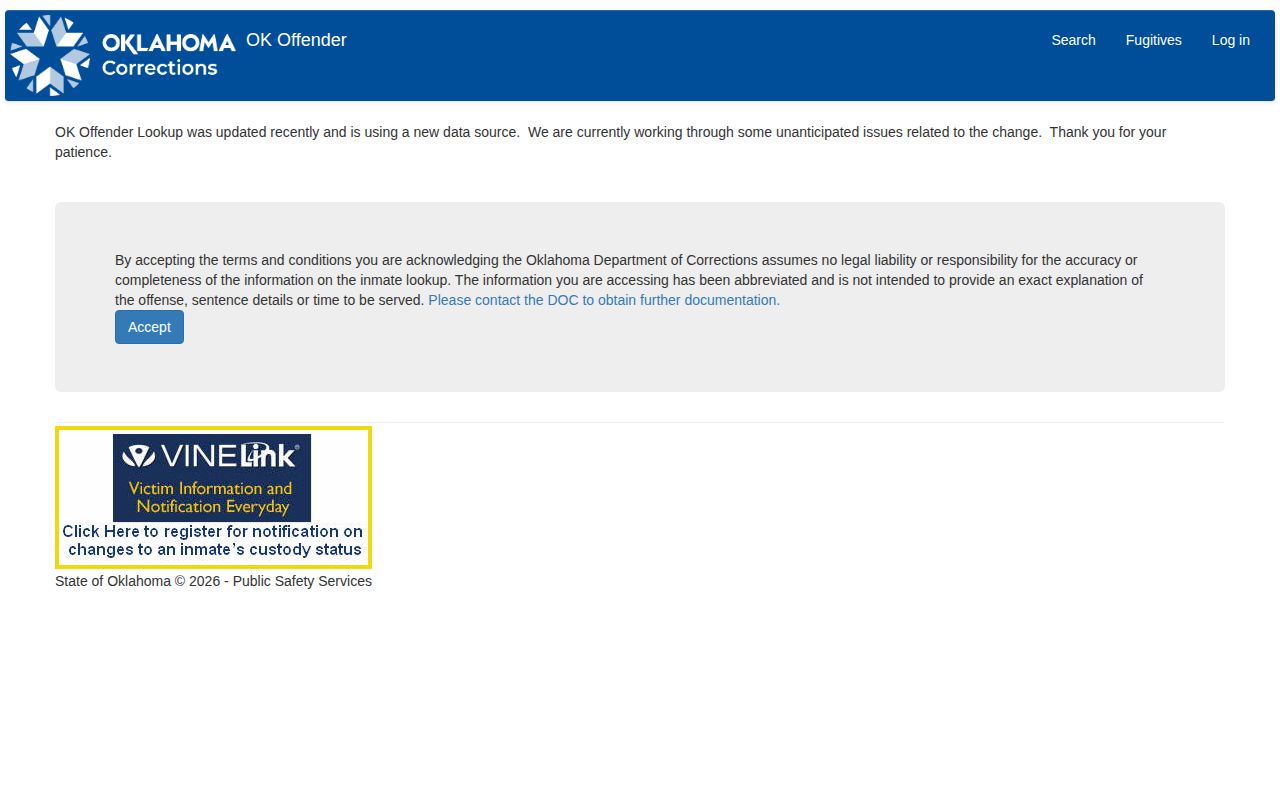
The image supports the state-prison search route, but a Texas County jail sentence still requires the Sheriff and court records.
Texas County ODOC Earned Credits
Oklahoma does not use one universal subtraction called “good time.” Title 57 § 138 uses ODOC class levels and monthly earned-credit rules, along with achievement or other credits, restrictions, deductions, and possible restoration. The correct table depends on the sentence and offense date. Credits can change PRD, but they do not rewrite the court's judgment.
ODOC projection material warns that its class-level table does not apply to restricted-earned-credit sentences. Misconduct can reduce credits or lower classification. Qualifying achievement can add credits. A sentence modification, an additional case, corrected jail credit, escape time, or a recalculation can alter the estimate. That is why a simple calculator that subtracts a fixed percentage would be unreliable.
The controlling record may also contain a Certificate of Release or Consolidated Record Card. A narrow request through ODOC Open Records can identify the sentence-calculation page or release certificate needed, subject to lawful limits. Specify the full name and ODOC number.
Check whether jail credit was entered for every qualifying period before using any projection. A correction to time credited before ODOC reception can move the calculation without changing the sentence imposed. Additional concurrent counts may share time, while consecutive counts extend the sequence. A suspended portion is also different from a term to be served in confinement. These details come from the judgment and official calculation, not a date copied from a summary result.
Earned credits are conditional records, not a prediction that future conduct or classification will remain unchanged. Preserve the class level and access date if official material shows them. When a later calculation differs, compare the intervening sentence or credit record rather than assuming that one date was fabricated.
Texas County 85-Percent Release Limit
Title 21 § 13.1 requires a person convicted of an enumerated felony within the statute's applicable date regime to serve at least 85 percent of the imprisonment sentence before parole consideration. Credits cannot reduce service below that floor. The offense list has changed, so the statute version tied to the offense date matters.
The 85-percent point is not a promised release date. It is a minimum-service restriction connected to parole consideration and credit effects. The Board may deny parole. Conditions may remain unmet. A consecutive sentence may begin, or another agency may hold the person. Sentences outside § 13.1 follow other eligibility and credit rules, including the detailed distinctions in Title 57 § 332.7.
Do not reduce an Oklahoma release estimate to “one third versus 85 percent.” Offense date, mandatory minimums, violent or nonviolent classification, sentence structure, and statutory exclusions can all change the path. The court judgment and official calculation control.
Parole eligibility itself varies by offense date. Title 57 § 332.7 includes older matrix treatment, a general one-third framework for certain qualifying crimes in one date range, and a general one-fourth framework for certain later qualifying crimes. Mandatory imprisonment and exclusions must be applied first. Those fractions describe eligibility rules, not an automatic Texas County prison-release schedule.
Why Texas County Release Dates Change
A projected release date is recalculated as the official sentence record changes. Some events affect earned credits, while others create a new legal or custody barrier. Record the access date whenever a PRD is copied. A later official screen may differ without either screen being an error.
| Factor | Possible effect | Record to check |
|---|---|---|
| Earned-credit level | Changes the rate at which qualifying credits accrue | ODOC calculation record |
| Misconduct | May reduce credits or classification | ODOC sentence administration |
| Achievement credit | May add qualifying credit | ODOC record |
| Jail-credit correction | Changes credited time already served | Court order and ODOC calculation |
| Consecutive case | Requires another term to follow | Judgments for all cases |
| Detainer or hold | May cause transfer or continued custody | Custodian discharge destination |
| Parole action | May alter the route but does not itself prove departure | PPB result and ODOC status |
A court order can authorize a change before jail or prison staff finish processing. The actual Texas County jail-register entry remains the local timestamp after a county release.
Texas County Jail Credit Formula
County-jail and ODOC calculations use different statutes. Title 57 § 65 gives a qualifying convicted person serving a county-jail term five days of credit for every four days served when the prisoner satisfactorily follows the sheriff's rules. It does not apply merely because a pretrial detainee is confined. This distinction is the central Texas County release-date computation angle.
Do not apply an ODOC PRD table to the Texas County Detention Center. Ask the Sheriff for the local calculation record and the Texas County Court Clerk for the judgment. No Texas County-specific implementation policy or weekend-release rule was verified, so neither a weekend adjustment nor a local release hour should be invented.
Even a sound county calculation remains prospective. Oklahoma's jail-register law records the date or manner of discharge or escape after the event. That field confirms what occurred and whether the person entered the community or transferred to ODOC, another county, a federal authority, or ICE.
Confirm Texas County Actual Release
After a forecast date arrives, check the agency holding the person. For ODOC, read the current offender status and request a Certificate of Release when needed. If supervision follows, the Guymon Probation and Parole office can confirm public routing information. For county custody, ask the Sheriff for the jail-register discharge entry.
Oklahoma VINE can send a custody-change alert, but a notification is not a certified timestamp. Registration and limits are explained on the Texas County VINELink Release Check. The broader Texas County release-record route shows how to pair the discharge entry with the court disposition.
Preserve the exact terms used by each source. “Released,” “discharged,” “paroled,” “transferred,” and “not in custody” do not always describe the same legal or physical event.
For a state sentence, compare the PRD with the current status only after checking whether another count, consecutive term, or detainer appears in the judgment and sentence record. A parole result can change the route without ending custody that day. ODOC processing and any receiving agency determine the physical handoff. The Certificate of Release is stronger proof than a forecast copied before the event.
For a Texas County sentence, ask for the actual date and manner field, not merely a verbal estimate. If the record says transferred, keep the destination and search that custodian. If it says a community release manner, compare the jail timestamp with the court order. The order may authorize release before staff finish identity checks, property return, transport, and other processing. These records answer related questions but should not be forced into one timestamp.
Note: When another hold exists, the end of one sentence may lead to transfer rather than community release.