
Texas County VINELink Coverage
Oklahoma VINE is the state's confidential custody-information and notification program. The Oklahoma Attorney General's VINE information describes round-the-clock access by web, app, or telephone at 1-877-654-8463. Available alert channels include app notices, telephone calls, email, text messages, and TTY. Official state material says the program tracks people in Oklahoma county jails and ODOC.
No source reviewed for Texas County listed the county separately in a complete participation table. A matching record that names the Texas County reporting agency is strong evidence that the feed covers that custody episode. An absent result must be checked with the Texas County Sheriff. Spelling, data delay, restricted information, or a different custodian can all explain a miss.
Coverage is defined by custody system. Oklahoma VINE does not replace the BOP Inmate Locator, ICE locator, or a federal court record. It is also not the public offender registry. The registry covers only people who have a legal registration duty, while VINE follows custody events reported by participating agencies.
Search One Texas County Inmate
Open the official Oklahoma VINELink page and use the “Find an Offender” function. Search one person at a time. The safest match uses an agency or offender identifier, but a complete name can begin the check. Read every identifier displayed before selecting a record. Similar names are common, and an incorrect match can attach the wrong release status to a person.
- Choose Oklahoma as the jurisdiction. Do not use another state's page merely because a name appears there.
- Enter the full name or available ID, then review the results for the correct reporting agency.
- Open the matching record and compare all identifiers supplied on screen.
- Read the custody-status wording exactly. Note the reporting agency and the time or date context shown.
- If the record says released or out of custody, contact that agency for the discharge date, manner, and destination.
A county-jail status is not an ODOC sentence history. Likewise, an ODOC result does not prove that a brief Texas County booking occurred. When no match appears, try a known spelling variant and identifier, then call the Sheriff's office at 580-338-4000. The full Texas County release-record search explains the sheriff-register and court-docket fallback.
The current interface can change its labels. The successful manifest capture preserves the Oklahoma-specific form and notification path. Review the VINELink source interface alongside the image.
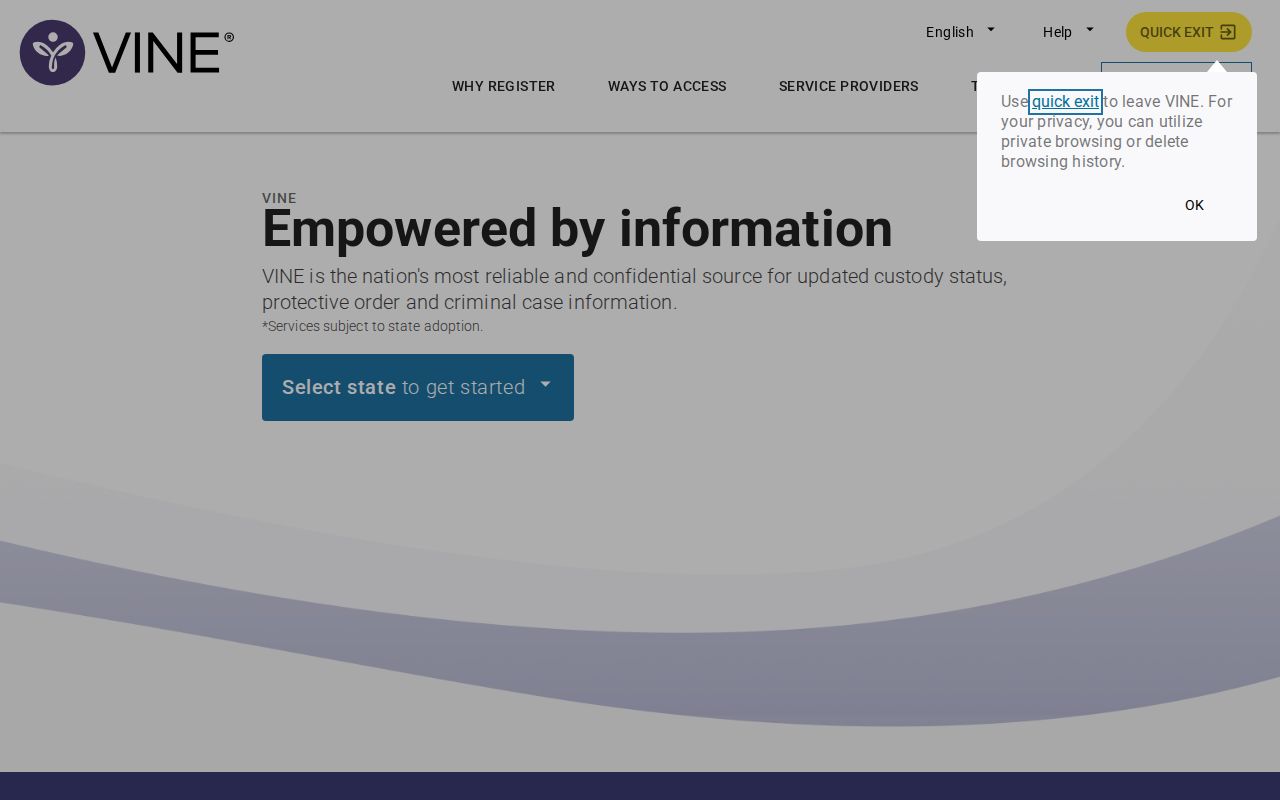
The screen provides a starting point for a specific-person check, while the reporting agency remains responsible for the underlying custody record.
Texas County VINELink Release Fields
VINELink displays what the participating agency sends and what the current interface permits. The available fields can vary by record. A status indicating released or no longer in custody is a lead that the custody episode changed. It may not state whether the event was bond, time served, dismissal, transfer, escape, or another outcome. Texas County's jail register is the better source for the exact discharge manner.
| Field | Meaning and limit |
|---|---|
| Jurisdiction | The selected state system, which should be Oklahoma for this check. |
| Reporting agency | The jail or corrections agency supplying the custody event. |
| Name or offender ID | Matching information used to separate people with similar names. |
| Custody status | The agency's current reported status, not a certified historical discharge record. |
| Location | The reporting facility or custody placement when made available. |
| Notification choices | The alert channels currently offered for that record. |
A transfer can remove someone from one agency's custody while placing that person in another's. Do not translate “out of custody” into “free in the community” without the destination. If a Texas County discharge went to ODOC, search ODOC next. If it went to ICE or a federal authority, use that system's locator.
Register Texas County Release Alerts
Notification begins from the correct matching record, not from a general name search. Choose each desired delivery method that the interface offers. Telephone notification uses a four-digit PIN to acknowledge the call. Official Oklahoma guidance says VINE may leave a message and continue calling until the PIN is entered or for up to 24 hours. Calls may arrive overnight because custody events do not follow office hours.
- Open the verified person's record and select the notification prompt.
- Choose phone, email, text, app, or another offered channel. More than one number or email may be registered.
- Enter the requested contact details carefully. Create the four-digit PIN when registering telephone calls.
- Complete any email or text confirmation required by the current interface.
- Save the registration confirmation and keep the PIN available to the intended recipient.
A forgotten PIN can be handled by calling 1-877-654-8463 and choosing live support. The PIN acknowledges an automated telephone notice; it is not an inmate ID or a release code. Update registration details when a number or email changes. No alert should be guaranteed because source feeds and delivery networks can lag.
Registering more than one available channel can reduce the risk of a missed notice. Direct confirmation is still needed when a court date, pickup plan, or time-sensitive legal step depends on the exact event.
Plan for the content of the notice to be limited. An alert may state that custody changed without explaining the case disposition, bond, sentence credit, or receiving agency in full. Save the message and note when it arrived, then ask the reporting agency for its release or transfer entry. If a pickup depends on the event, verify location and timing directly because VINE does not promise a public release door, waiting area, or processing time for the Texas County Detention Center.
Alert registration should follow the person across each available reporting record only when the interface offers that choice. A Texas County jail record and a later ODOC record can represent separate custody stages. Registering on the first does not guarantee that the second agency's future changes will be covered under the same confirmation. Review the agency name after a transfer and register again only through the official matching record when needed.
Texas County Parole Notification Gap
Oklahoma VINE spans county-jail and ODOC custody changes, but the Pardon and Parole Board's VINE page states that it does not provide parole notifications. PPB victim notification is a separate registration. A person can therefore be properly registered for a custody alert yet need a second official channel for parole proceedings.
VINE may also be inactive during the specific period when an ODOC inmate is transferred to an Oklahoma Department of Mental Health facility. Service can resume after return to ODOC. This narrow exception explains why silence from the automated service cannot prove unchanged custody. Check ODOC, PPB, or the named facility directly when the known facts point to that path.
The parole split is important in Texas County. The Guymon ODOC office handles field supervision, while the Board publishes parole dockets and results. A VINE notice cannot replace either record. A Board result, in turn, does not confirm that ODOC completed release processing.
Parole dockets show scheduled consideration, and results show the Board's recorded action. Wording such as denied, passed to another stage, favorably recommended, or parole to a consecutive sentence must be preserved. None should be replaced with a VINE-style “released” label. After the Board acts, ODOC status and release documentation establish whether a custody change was executed.
Confirm Texas County VINE Results
Automated custody data can be delayed, miss a spelling, omit a protected case, or reflect only one agency. VINELink also does not supply the complete court reason for release. For a Texas County jail event, request the Sheriff's jail-register entry showing the date or manner of discharge or escape. For an ODOC event, compare Offender Search status and seek a Certificate of Release when documentary proof is needed.
The Oklahoma offender registry is separate and narrow. Its public profiles may include a current photograph and registration status for covered people, but it is not a general VINELink archive. Most released people are not represented there, and absence does not resolve a release question.
Federal and immigration custody need different routes. The BOP locator can show a federal release date or that someone is not in BOP custody. ICE has its own locator. A county discharge to either agency is a transfer, so the Texas County record should be kept with the next system's result.
Keep a simple event log when confirmation matters. Record the name searched, identifiers used, reporting agency, displayed status, access time, alert-registration channel, and the office contacted afterward. This avoids treating an old screen as current and makes conflicting dates easier to resolve. The court-order date, VINE alert time, jail processing time, and agency discharge timestamp may be different without contradiction. Ask which record created each date.
If the Sheriff confirms a transfer, follow the named destination instead of continuing to refresh the Texas County record. An ODOC transfer leads to Offender Search. An ICE or federal handoff leads to the matching federal locator. If the Sheriff reports community release, the jail-register manner and court docket provide the stronger local explanation. This agency-by-agency method prevents a single automated message from being stretched beyond its coverage.
Note: VINE is best used for notice and follow-up, while the agency record confirms the event and destination.