
Oklahoma Board Release Role
The Oklahoma Pardon and Parole Board holds proceedings and publishes dockets and results for eligible ODOC prisoners, including cases that began in Texas County. It handles parole and clemency decisions within its legal authority. ODOC holds and releases state prisoners, calculates sentence dates, and supervises people in the community. Keeping those roles separate prevents a Board event from being reported as an actual prison exit.
A docket is a schedule. A result records the action taken. Some actions are final within the Board's role, while others need another stage, gubernatorial action, a program condition, or ODOC execution. The person's current offender status and release document answer whether confinement ended. The Texas County jail register is still the correct source for an earlier county detention episode.
Search Oklahoma Parole Dockets
The Dockets and Results hub is organized by year and month. It provides separate docket and result links. Current combined material may include parole, administrative parole, Stage One commutation, and SIR categories, as well as pardon material. A separate official docket-search page is also available.
- Use the DOC number when known because it distinguishes people with similar names.
- Select the correct year and month or open the Board's docket-search tool.
- Match the DOC number, county, case, and hearing category.
- Read the corresponding result and preserve its exact action wording.
- Check ODOC afterward for the executed custody, release, or supervision status.
The official monthly source is shown below. Its paired docket and result links support the sequence, but neither replaces the state corrections record.
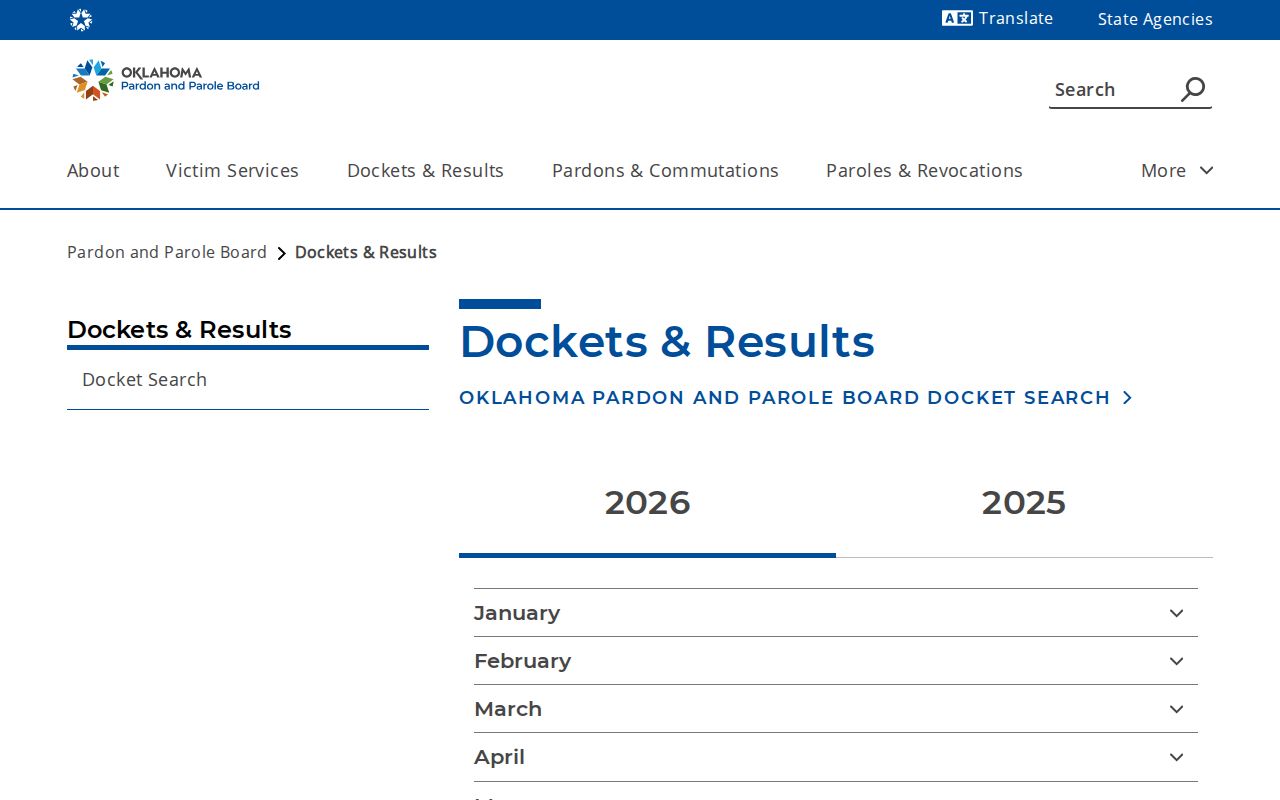
The image helps locate the official action, which must then be checked against ODOC execution.
Read Oklahoma Parole Results
Board wording has precise consequences. A denial is not release. A matter passed to Stage II remains in the process. A favorable recommendation can require action beyond the Board. Parole to street may point toward community release, but conditions and ODOC processing still matter. Parole to a consecutive sentence means the person continues serving another sentence rather than entering the community.
| Result wording | Safe interpretation | Required follow-up |
|---|---|---|
| Denied | Requested relief was not granted at that proceeding | Check later dockets and ODOC status |
| Passed to Stage II | Another decision stage follows | Find the later Board action |
| Favorably recommended | A recommendation, not automatic release | Check further required action and ODOC |
| Parole to street | Community release may follow if executed | Confirm actual ODOC release and supervision |
| Parole to consecutive sentence | Custody continues under another sentence | Read sentence and ODOC records |
| Stricken | The matter was removed from the setting | Do not infer a release decision |
Other conditions may appear. Quote them rather than translating them into a simple yes or no. Program requirements can delay street release. A violent-offense recommendation can involve the Governor. The full result, not a clipped heading, controls the interpretation.
Note: Board action date and physical release date are separate events and can appear in different official systems.
Oklahoma Board Meeting Records
The official Board Meetings page publishes annual dates, current regular meeting information, agendas, minutes, location or remote details, and archives. The history shows generally monthly regular proceedings. Still, a reader should check the current page for a cancellation, special setting, remote arrangement, or date change rather than rely on an assumed weekday.
A meeting calendar does not show that a named person was granted release. Use the docket for the scheduled person and category, then the results for the recorded action. Minutes and agendas supply meeting context but should not replace the person-specific result.
The current meeting source is captured below. It shows where official scheduling is published and why a fresh check matters.
The meeting page establishes the proceeding calendar, while ODOC remains the source for executed release status.
Oklahoma Board Records Contact
The Board's official site provides agency contacts and its public docket, results, and meeting material. The verified research lists the office address below but directs readers to the current contact page rather than supplying an unverified telephone number. Use the DOC number, county, case number, and meeting month when asking about a published record.
4345 N. Lincoln Blvd., Suite 1082
Oklahoma City, Oklahoma
Dockets and results: official PPB website
Meetings: official Board Meetings page
Contact: use the current PPB contact page
The Board is not the office to call for a Texas County jail discharge entry or an ODOC facility release certificate. Direct county booking questions to the Sheriff. Direct state custody and Certificate of Release questions to ODOC. Use the Board for its own dockets, results, minutes, and process records.
Oklahoma Parole Eligibility Records
Parole eligibility is governed chiefly by 57 O.S. § 332.7, with differences tied to offense date, offense type, mandatory terms, and procedure. The current framework includes older matrix rules for crimes before July 1998, a general one-third rule for qualifying crimes from July 1998 through October 2018, and a general one-fourth rule for qualifying crimes from November 1, 2018 forward. Those shorthand rules do not resolve every case.
Title 21 § 13.1 imposes an 85-percent restriction for listed offenses in the applicable date regime. It is not a rule that every Oklahoma prisoner serves exactly 85 percent. Mandatory minimums, consecutive terms, sentence structure, exclusions, and offense dates matter. Death and life-without-parole sentences are not parole eligible.
Some situations do not receive a standard parole-consideration date under the administrative rules. Examples include specified short-to-discharge reception cases, some revocation custody, death, life without parole, sentences served outside ODOC, and other listed circumstances. Use the law and record applicable to the person rather than a broad formula.
- Parole eligibility
- The point when parole consideration may occur, not a release promise.
- Projected Release Date
- An ODOC estimate distinct from parole eligibility.
- Mandatory term
- A required period that must be served before a later step can occur.
- Consecutive sentence
- A term served after another term, which can continue custody after parole action.
Confirm Oklahoma Parole Release
After reading a favorable result, search the ODOC Offender Search. Match the DOC number and preserve the exact status. Community supervision can show that prison confinement ended while parole remains active. An incarcerated listing means state confinement continues. A released or discharged history should be read with its date label and access date.
For stronger documentation, request the ODOC Certificate of Release, DOC 060211N, or the narrow release record needed. Current sentence-administration policy ties that certificate to release and reporting instructions. When supervision follows, the release package routes to the proper probation and parole region.
The Oklahoma Department of Corrections release page explains the statewide lookup and record distinction. The Board cannot provide a county jail register, and ODOC does not replace the Texas County court file that identifies the originating case.
Note: Preserve the Board term, ODOC status, and certificate date as separate facts rather than merging them into one release statement.
Texas County Parole Records
A case originating in Texas County can appear in Board materials with the county, case, DOC number, hearing category, and sentence facts. Confirm all of those identifiers. County of conviction does not mean the person is housed in Texas County. No ODOC prison was identified as physically located there.
If release is executed and the person is assigned to Texas County supervision, the ODOC office table currently routes Texas, Beaver, and Cimarron counties to Guymon. That office handles field supervision, not Board decisions. A person can therefore move from a prison elsewhere in Oklahoma to community reporting in Guymon.
Custody notifications and parole notifications also follow different routes. Oklahoma VINE can report qualifying county-jail and ODOC custody changes from participating feeds, but Board guidance says VINE does not provide parole notifications. A person with a need for Board notification must use the Board's separate victim-services process. Neither alert system replaces the monthly result or the ODOC release record. Save any notice with its time and source, then compare it with the official action and executed status.
A Texas County court docket remains useful after Board review. It identifies the originating case and sentence, while the Board record identifies the parole action. The state corrections record then shows whether the person is incarcerated, supervised in the community, released, or discharged. These three sources should agree before a firm claim is made.
The full Texas County release-record search starts by identifying the last custodian. It is possible for a county defendant to bond out and never enter ODOC, for an ODOC prisoner to remain incarcerated after Board review, or for a paroled person to remain under supervision. Each path leaves a different record.